I'm Looking Over A Four-Leaf Clover

“I’m looking over a four-leaf clover that I overlooked before.”

This jaunty 1920’s song puts a smile on our face with thoughts of luck and joy discovered in simple actions. NextStage has a 4-leaf clover. What are the four leaves of the NSP clover?

  • One is to forward this NSP newsletter to a friend who needs connection.

  • Two is to volunteer as a board member or audition for a show.

  • Three is to attend a class or workshop.

  • Four is to donate through our NSP website, www.nextstagesantacruz.org

From the 1920’s to Willie Nelson and the Rainbow Connection to today.

“There’s no need explaining, the one remaining is somebody I(we) adore.”

- Kathryn Adkins

Here Comes The Sun

Mother Nature has once again shown us the way to create a deep cleaning with lots of water. What is revealed is brilliantly revealed. And so it is with NextStage.

2024 is our 10th Anniversary. We will be remembering the past and then embarking on a shining new path with more opportunities to polish our creative skills, renew our sense of empowerment and strengthen our connection with others.

We begin with Readers Theater performances already in rehearsals, followed by a vocal care workshop with Joanne Cazden. This summer schedule includes a creativity releasing workshop with Cindy Gorski and auditions for the September storytelling event directed by Brad Roades.

More will be coming. Watch for the dates and events. Don’t miss the fun and excitement!

- Kathryn Adkins

Spotlight on Julie Lorraine

I grew up in San Francisco and as a kid, I had the run of the city, being able to hop on a bus and go anywhere. My sister and I were involved in the San Francisco Children’s Opera, participating in Fairy tale plays with lyrics and libretto produced by Norbert and Hetty Gingold. As I entered High School,  we moved to Karlsruhe, Germany since my Dad was stationed there with the U.S. Army. Having the opportunity to travel in Europe helped me gain awareness of multi-cultural perspective.  I have sung in community choirs (currently Fiat Musica) most of my adult life, and it brings me a great deal of joy.  I am part of a book club, which meets monthly and have had an opportunity to expand the range of authors and genres I have encountered. I love hiking, and being physical as much as possible.

With degrees in Special Education, I taught with both the Santa Cruz County Office of Education and Pajaro District for many years. I learned a great deal from the children and their families, which has stood me in good stead in my current situation.

These days, you can find me involved in many activities designed for people living with Parkinson’s Disease. I serve as President of the Board of Directors of EASE PD (Exercise, Activities, Support and Education for Parkinson’s Disease). Whether it be Taiko, Voice and Movement, or attending NSP events, collaboration with NextStage has made a big impact on my life.  I have seen the effect of these classes, as they not only combat isolation, and promote community, but preserve skills and generate new cognitive pathways in staying healthy and fighting for the best quality of life possible. My husband, Barry, is an active participant with NextStage sponsored classes.

I love the NextStage people who give so much of themselves to boost the lives of people living with a chronic, neurological, progressive disease.  Their optimism and enthusiasm are infectious and speaks to the power of community. They see people as individuals each with unique needs that can be enhanced!

Happy 2024!

Happy 2024!  We kick off celebrations for 10 years of NextStage Productions in Santa Cruz!

What a journey. From our inception in 2013 as Stagebridge Santa Cruz under the mentoring of Oakland Stagebridge to the full 501c3 legal status in 2014. A decade of marvelous performances, classes, health and joy to our senior community.

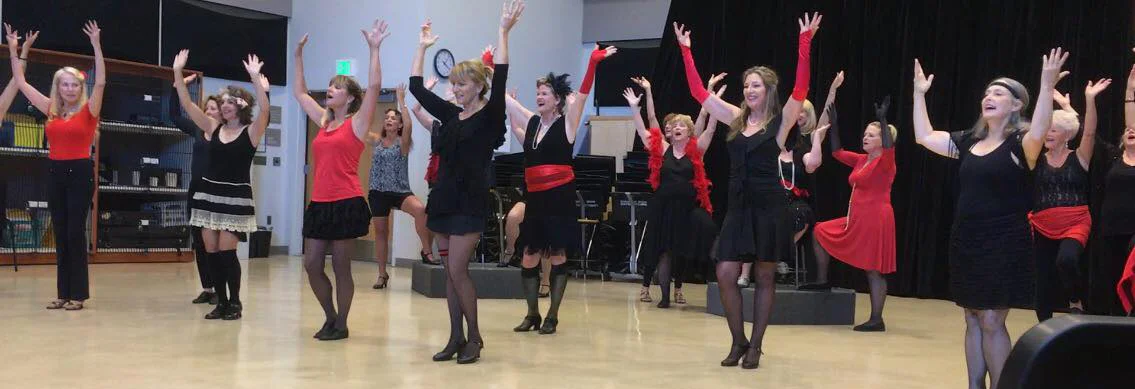
What fun we’ve had over the years - being a bit dramatic and decadent, singing “Come to the Cabaret” in our musical theater classes. We’ve kicked up our heels, saluted our heroes, razzle-dazzled our audiences, played games, written sensitive letters, told our stories and so much more. We’ve created stories with our memory loss clients, banged drums and stretched our bodies reaching for better mobility and health.

And we’ve even learned to navigate Zoom and streaming.

NSP is built on the dedication of so many members and teachers, advisors and participants, especially Lynn Knudsen who’s drive and vision created the framework for where we are today.

As we launch into this year of celebration, reminisce and then renew your dedication to NextStage Productions and all that we do. Volunteer as a board member, a director, a teacher, a performer. WE WELCOME EVERYONE. The rewards are plentiful.

- Kathryn Adkins

How Music Affects The Brain


AARP has a really great online article called The Extraordinary World of Music and the Mind. It discusses how for more than 50 years, music therapy has harnessed music to treat diseases ranging from depression to chronic pain to movement disorders to autism to Alzheimer’s disease. 

Music’s power over us is not purely psychological but based in measurable physiological changes. Singing along with others to a beloved song causes the brain to secrete the chemical oxytocin, a naturally occurring hormone that creates the warm sensations of bonding, unity and security that make us feel all cuddly toward our children and others we love; infuses us with feelings of spiritual awe; and can alleviate chronic pain or the debilitating sensations of anxiety or the isolation of autism. One area of medicine where the power of music has been particularly remarkable is in the treatment of the dementias, including Alzheimer’s disease, whose stubborn and terrible symptoms have been resistant to most forms of treatment.

Research has shown that when rhythmically strong music was played to people with Parkinson’s disease and those recovering from stroke, they synchronized their walking gait with the music and moved more quickly and with better joint control. The therapy is called rhythmic auditory stimulation. “Stroke patients walk much more symmetrically and faster,” Thaut told me recently over Zoom. “Parkinson’s patients don’t have that shuffle and tendency to fall over.”

Other studies looked at the effects of “autobiographically salient” music that Alzheimer’s patients had loved and listened to for 25 years or more. The beloved, familiar music, when played to patients in the fMRI scanner, lights up a large network of the brain — including in the frontal lobes, where higher-order reasoning and memory are processed, a clear and objective sign of a musical “memory trigger” for people with dementia. They recognize it in terms of ‘that is music I know, I know what that is! That is the music I danced to when I met my wife.’ This activation spreads throughout the entire cortex — and the whole neural network comes alive. Alzheimer’s patients who listened to personal playlists of favorite music daily and talked about what they could remember with their spouse or caregiver for one hour a day for four weeks showed significant improvement on memory tests.

All of this backs up the importance of our NextStage Taiko Drumming programs, and the work of NextStage Performers sharing the songs we first fell in love with in our teens and early 20s — that period of life when most people form their musical tastes. 

A friend of mine was recently filling out her health care directives, and was surprised that the questions included a space to enter her 50 favorite songs. She's hoping passing these songs to her future caregivers can keep a tap in her toes and a spark in her mind as she ages.